
Would One Universal Language Benefit Humanity?
You’ve probably heard of the Tower of Babel, a biblical story from Genesis Chapter 11 that explains (metaphorically) why the languages in our world today are scattered and vastly different.
To summarise, the people in the land of Shinar spoke one singular language and attempted to build a tower to heaven out of pride and a wish to make a name for themselves. The Lord punished them and “confused the language of the whole world”, leaving people and languages vastly different from each other.
It’s clear that this story is not the actual origin of language, but it illustrates the belief I would like to discuss today: the notion that a unified language would grant humans unparalleled power as a species.
On the surface, this may seem logical, but look at the technicalities of language and its effects, and you’ll realise that one unified language would be more detrimental than beneficial to the human race.
Why do people want one universal language?
In my opinion, the idea of one universal language is something extremely dystopian and bleak. Think of ‘1984’ by George Orwell and Newspeak, a world devoid of the variety of languages we have now seems to be a world stripped of the colour, culture and diversity we know of today.
Nevertheless, people still dream of a universal language that we can all speak for multiple different reasons. In a podcast episode by Lingthusiasm, Gretchen McCulloch and Lauren Gawne discuss some intriguing motivations for a universal language. One of the most obvious reasons is universal communication, where everyone can understand each other. This is particularly helpful in social contexts, international politics, and so much more.
Related to this is the motive of world peace. Zamenhof, the creator of Esperanto, which is the most widely used constructed international language (we will look more closely at this later), had this exact motive. He sought to develop a neutral, universal language that would foster peace and unity. McCulloch raises a clear flaw in this reasoning that differences and political struggles are often not because of linguistic differences, but rather ideological and/or religious differences (or other fundamental differences) that cause these clashes. McCulloch and Gawne go on to describe people who want a universal language to be ‘optimists’, which I think is a great description because the feasibility of having all 8.3 billion people in the world speak one common language sounds like a far-fetched dream.
Previous attempts at a universal language (and why they failed):
Now that we know why some people may find the idea of one universal language appealing, I’d like to explore some attempts at creating a universal language and why they all failed.
Esperanto:
The most famous one that I have mentioned in the previous section is Esperanto, an auxiliary international language that impressively has 2 million speakers worldwide. (I also just found out that Esperanto is actually an available language on Google Translate too!)
Zamenhof was an idealist who, as mentioned above, wanted to create a new universal, neutral language so that everyone could understand each other. However, even though he had the best of intentions, many flaws in Esperanto do not make it neutral at all. Firstly, Esperanto borrows a lot of words from European languages and has a strong Romance sound to it (e.g. French, Spanish, Italian, Romanian, etc.) Not only this, but it also has similar consonant vowel sequences to Romance languages and some Slavic and Germanic influences fed through it as well. For example, the word for ‘dog’ in Esperanto is ‘hundo’, which is derived from ‘hund’ in German.
The heavy influence of European languages in Esperanto creates a blatant inequality in learning the language. The European languages make up only 3 to 4% of the world's total, yet they are the major influences behind Esperanto. This makes it extremely unfair for those who speak Asian, African or Aboriginal languages, because they will have to put in a lot more effort than a European language speaker to learn Esperanto. This is especially difficult for those who speak logographic languages like Chinese and Vietnamese, etc. Evidently, not very neutral, is it? There’s more!
In many Romance languages, the feminine terms are all diminutive or derived from the male term. For example, in Spanish, a male teacher is ‘profesor’, while a female teacher is ‘profesora’. Esperanto carries this forward into its own language, where the feminine terms derive from the male terms. For example, ‘kelnero’ is a waiter, while ‘kelnerino’ is a waitress. Esperanto is clearly aiming to be a neutral, universal language, but this universality just seems to include sexism as well!
Bliss Symbols:
Another example of an attempt to create a universal language was Bliss Symbols, created by Charles K. Bliss. Bliss was a Jewish prisoner who escaped World War 2 to, interestingly, Shanghai. After firsthand experiences of the atrocities of war, he wanted to create a unifying world language. Bliss drew inspiration from the Chinese language and created symbols that represented specific words.
Examples of Bliss symbols:
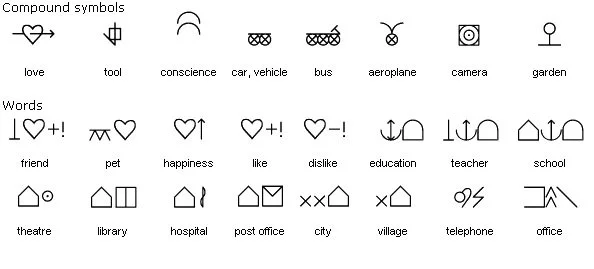
Bliss symbols were a failure until the 70s, when they were found to be very helpful for special needs children, but that is a story for another time.
The point is that there have been numerous attempts to create a ‘universal’ language, particularly in specific industries. The aviation industry has slowly been transitioning to all flight cues being in English, while the language of space is English and Russian, so astronauts learn to speak both during their training (as I found out in Atmosphere by Taylor Jenkins Read - a phenomenal read!)
Aside from specific industry cases, the attempts to make one singular, unifying language for all of the over 8 billion people in the world are plenty, but they all share something in common: none of them have succeeded in their aim.
Why is one universal language highly idealistic and borderline impossible?
The answer to why having one universal language is so idealistic can be answered in many ways, but they mostly boil down to the fact that languages are naturally dynamic and divergent. It is simply impossible for there to be one singular language because even if everyone learnt this one language, accents, idioms, dialects, neologisms, and other unique aspects of language would naturally creep in, creating distinctly new languages anyway. Language is an ever-changing vessel that develops according to the people who speak it, people whose change is impossible to control.
Even in the numerous languages we have in the world today, many of them have dialects, accents, and more that are specific to different regions or cultures. It is just unfeasible to expect the entire human race to be able to adopt one common language, and it is even more unfeasible to expect this language to remain the same without oppression and force, which contradicts the whole intention behind having a universal language for peace in the first place.
What would we lose with one universal language?
The blaringly obvious thing that we would lose if we implemented a universal language is cultural and linguistic diversity. According to Dan Fitzgerald, a Washington D.C.-based French instructor, the costs of removing the world's thousands of languages would be enormous, saying “much of the culture that goes along with each of those languages would also disappear”.
As mentioned earlier, language is an intrinsic part of culture and tradition and essentially, what forms our identity. Forcing a monolingual blanket over the world would mean losing thousands and thousands of years of heritage that is much more precious than a potentially unfulfilled promise of unity. Languages should continue to be protected, especially in an increasingly anglicised world where we see more and more languages becoming extinct every year, while more and more people learn more common ‘standardised’ versions of language due to the opportunities they open up in the professional world of work. Linguistic change is a natural process that should not be forced to speed up or slow down by external pressures, but instead, should be preserved and celebrated for all it does for us in every second of every day.
Links to additional resources:
Lingthusiasm episode 1 (‘Speaking a single language won’t bring about world peace’)
Article - What If Everyone on Earth Spoke the Same Language? | HowStuffWorks.
